Field: Technology
A Meteorite From the Moon Illuminates Ancient Asteroid Cataclysms Across the Solar System
Published June 17, 2026 | Technical Staff
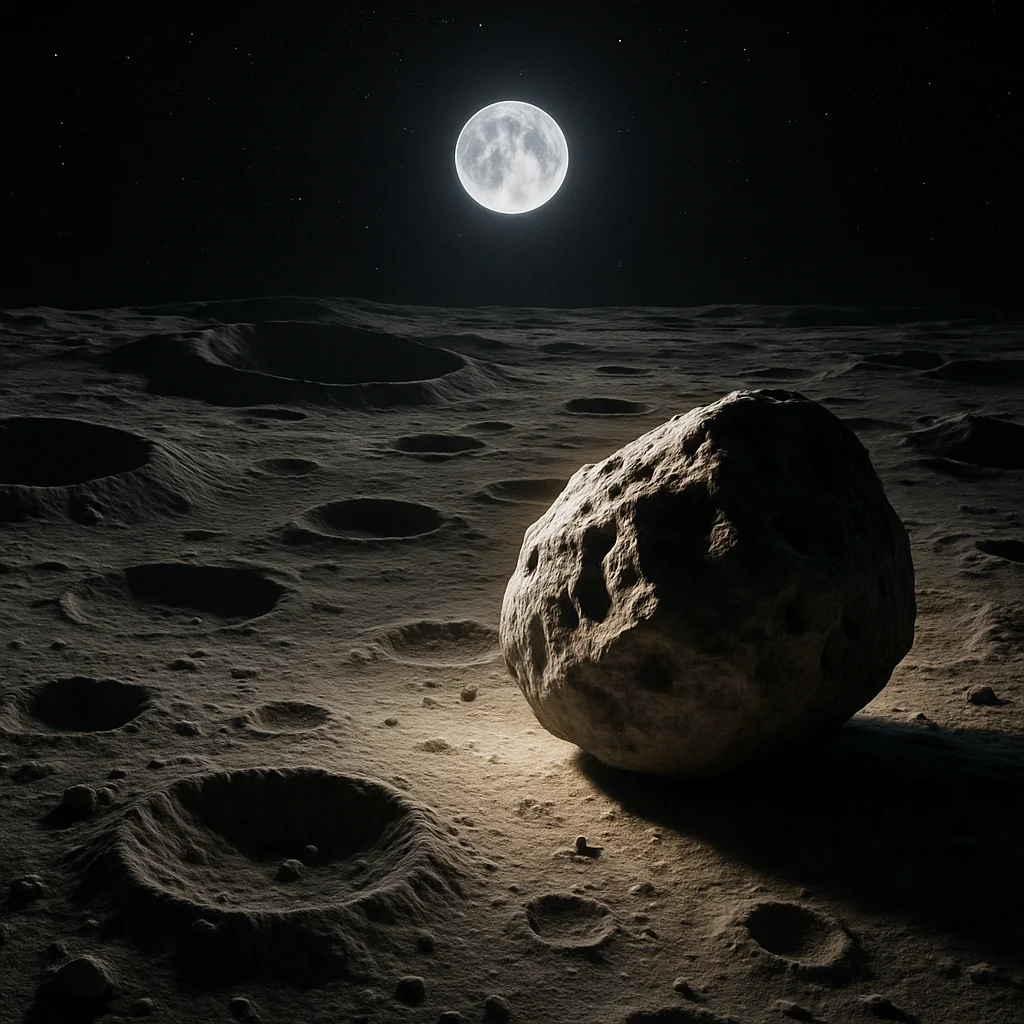
Visualization
In a remarkable intersection of planetary geology and cosmic history, the lunar meteorite Northwest Africa (NWA) 12593 has emerged as a silent witness to some of the most violent episodes in the inner Solar System. Planetary scientists led by Dr. Carolyn Crow at the University of Colorado, Boulder, have subjected this unassuming rock to rigorous analysis, unearthing evidence of a cataclysmic asteroid impact that devastated the lunar surface approximately 3.5 billion years ago. Their findings not only shed light on the chronology of lunar bombardment but also anchor a period when Earth was undergoing profound transformations—giving rise to the first life, the atmosphere, and primordial oceans.
NWA 12593, a 7.53-gram sample collected in Africa, encapsulates a triad of impact events, each a distinct layer in the geological palimpsest of the Moon. Utilizing X-ray fluorescence (XRF) mapping, researchers constructed spatial distributions of major elements such as calcium (Ca) and iron (Fe) to trace the location and identity of clasts, the rocky fragments fused within the meteorite’s matrix. Sulfur (S) signatures further illuminated crack networks and traces of terrestrial weathering—a testament to the rock’s odyssey from the lunar surface to the Sahara.
At the heart of this stone lies unequivocal evidence for a primordial impact registering among the largest the lunar surface has ever endured. Radiometric dating techniques, employing isotopic systems likely based on U-Pb or other refractory isotope chronologies, establish the age of this event at circa 3.5 Ga (giga-annum, or billion years ago). The collision's magnitude was sufficient to liquefy vast expanses of the Moon’s crust, transforming it temporarily into a silicate melt sea. The thermal spike induced by this event was so intense that it catalyzed the synthesis of cubic zirconia (ZrO₂), a high-pressure, high-temperature polymorph of zirconium dioxide. Commonly encountered in laboratory settings, cubic zirconia rarely survives in natural environments because, absent highly controlled cooling protocols, it readily inverts to lower-temperature forms. Here, however, 'cubic zirconia phase heritage' is discernible, embedded as vestigial traces within the meteorite’s structure—a mineralogical fingerprint of extraterrestrial cataclysm.
This initial shock was not to be the end of the meteorite’s saga. NWA 12593 is fundamentally a breccia—a composite rock agglomerated under subsequent impacts. Analogous to terrestrial concrete, in which disparate stones are cemented utilitarily, lunar breccias integrate fragments from multiple lithologies, their cohesion achieved by the immense mechanical and thermal forces of additional impacts. At least one later event fractured the primordial impact melt sheet, encapsulating a patchwork of clasts within a shock-welded matrix. This brecciation chronicles the continuing vulnerability of the lunar surface to bombardment, even after its initial transformation.
The final insult, recorded in the stone’s current presence on Earth, was a relatively more recent impact—one that ejected the breccia from its lunar birthplace with escape velocity (v_esc ≈ 2.38 km/s), setting it on a trajectory that would ultimately deposit it in the Northwest African desert. Each of these sequential impacts is inscribed in NWA 12593’s texture, composition, and isotopic memory, allowing scientists to reconstruct a chronology that bridges the Moon with other celestial bodies.
What renders this specimen particularly compelling, however, is the remarkable synchronicity of its oldest recorded impact with corresponding signatures found in geological records on both Earth and the asteroid Vesta—the fourth largest asteroid in the Solar System. This correlation denotes a period during which the entire inner Solar System endured a crescendo of collisions, as planet formation gave way to the residual dynamism of asteroid belt instabilities. The terrestrial record, notoriously fragmented due to tectonics, subduction, and relentless weathering, rarely preserves evidence from this Hadean-Archean transition. Yet the detection of similarly timed bombardment scars across three distinct worlds—Earth, Moon, and Vesta—provides an invaluable anchor for planetary scientists decoding the cadence and consequences of early Solar System dynamics.
Such multibody corroboration feeds directly into grander questions concerning the evolution of life’s earliest stages on Earth. Fossil records indicate life was already extant by 3.5 Ga; thus, understanding the magnitude and frequency of planetary bombardment at that epoch is essential for evaluating the environmental stresses under which life emerged and adapted. The magnitude of these impacts, their periodicity (λ), and thermal consequences (where the transient temperature T post-impact can be modeled via Stefan-Boltzmann law and shock thermodynamics) define the parameters of habitability thresholds for nascent biospheres.
Dr. Crow and her team’s publication in the May 2026 issue of *Geology* positions lunar meteorite NWA 12593 as an unprecedented Rosetta Stone for deciphering the late stages of the Solar System’s violent adolescence. Their work illustrates the rare confluence of records across multiple planetary surfaces, and augments our emerging narrative of planetary evolution—one punctuated by force, fire, and the tenacity of both rocks and, eventually, life itself.
NWA 12593, a 7.53-gram sample collected in Africa, encapsulates a triad of impact events, each a distinct layer in the geological palimpsest of the Moon. Utilizing X-ray fluorescence (XRF) mapping, researchers constructed spatial distributions of major elements such as calcium (Ca) and iron (Fe) to trace the location and identity of clasts, the rocky fragments fused within the meteorite’s matrix. Sulfur (S) signatures further illuminated crack networks and traces of terrestrial weathering—a testament to the rock’s odyssey from the lunar surface to the Sahara.
At the heart of this stone lies unequivocal evidence for a primordial impact registering among the largest the lunar surface has ever endured. Radiometric dating techniques, employing isotopic systems likely based on U-Pb or other refractory isotope chronologies, establish the age of this event at circa 3.5 Ga (giga-annum, or billion years ago). The collision's magnitude was sufficient to liquefy vast expanses of the Moon’s crust, transforming it temporarily into a silicate melt sea. The thermal spike induced by this event was so intense that it catalyzed the synthesis of cubic zirconia (ZrO₂), a high-pressure, high-temperature polymorph of zirconium dioxide. Commonly encountered in laboratory settings, cubic zirconia rarely survives in natural environments because, absent highly controlled cooling protocols, it readily inverts to lower-temperature forms. Here, however, 'cubic zirconia phase heritage' is discernible, embedded as vestigial traces within the meteorite’s structure—a mineralogical fingerprint of extraterrestrial cataclysm.
This initial shock was not to be the end of the meteorite’s saga. NWA 12593 is fundamentally a breccia—a composite rock agglomerated under subsequent impacts. Analogous to terrestrial concrete, in which disparate stones are cemented utilitarily, lunar breccias integrate fragments from multiple lithologies, their cohesion achieved by the immense mechanical and thermal forces of additional impacts. At least one later event fractured the primordial impact melt sheet, encapsulating a patchwork of clasts within a shock-welded matrix. This brecciation chronicles the continuing vulnerability of the lunar surface to bombardment, even after its initial transformation.
The final insult, recorded in the stone’s current presence on Earth, was a relatively more recent impact—one that ejected the breccia from its lunar birthplace with escape velocity (v_esc ≈ 2.38 km/s), setting it on a trajectory that would ultimately deposit it in the Northwest African desert. Each of these sequential impacts is inscribed in NWA 12593’s texture, composition, and isotopic memory, allowing scientists to reconstruct a chronology that bridges the Moon with other celestial bodies.
What renders this specimen particularly compelling, however, is the remarkable synchronicity of its oldest recorded impact with corresponding signatures found in geological records on both Earth and the asteroid Vesta—the fourth largest asteroid in the Solar System. This correlation denotes a period during which the entire inner Solar System endured a crescendo of collisions, as planet formation gave way to the residual dynamism of asteroid belt instabilities. The terrestrial record, notoriously fragmented due to tectonics, subduction, and relentless weathering, rarely preserves evidence from this Hadean-Archean transition. Yet the detection of similarly timed bombardment scars across three distinct worlds—Earth, Moon, and Vesta—provides an invaluable anchor for planetary scientists decoding the cadence and consequences of early Solar System dynamics.
Such multibody corroboration feeds directly into grander questions concerning the evolution of life’s earliest stages on Earth. Fossil records indicate life was already extant by 3.5 Ga; thus, understanding the magnitude and frequency of planetary bombardment at that epoch is essential for evaluating the environmental stresses under which life emerged and adapted. The magnitude of these impacts, their periodicity (λ), and thermal consequences (where the transient temperature T post-impact can be modeled via Stefan-Boltzmann law and shock thermodynamics) define the parameters of habitability thresholds for nascent biospheres.
Dr. Crow and her team’s publication in the May 2026 issue of *Geology* positions lunar meteorite NWA 12593 as an unprecedented Rosetta Stone for deciphering the late stages of the Solar System’s violent adolescence. Their work illustrates the rare confluence of records across multiple planetary surfaces, and augments our emerging narrative of planetary evolution—one punctuated by force, fire, and the tenacity of both rocks and, eventually, life itself.