Field: Technology
Ancient Interstellar Comet 3I/ATLAS Reveals a Chemical Time Capsule from the Early Milky Way
Published June 25, 2026 | Technical Staff
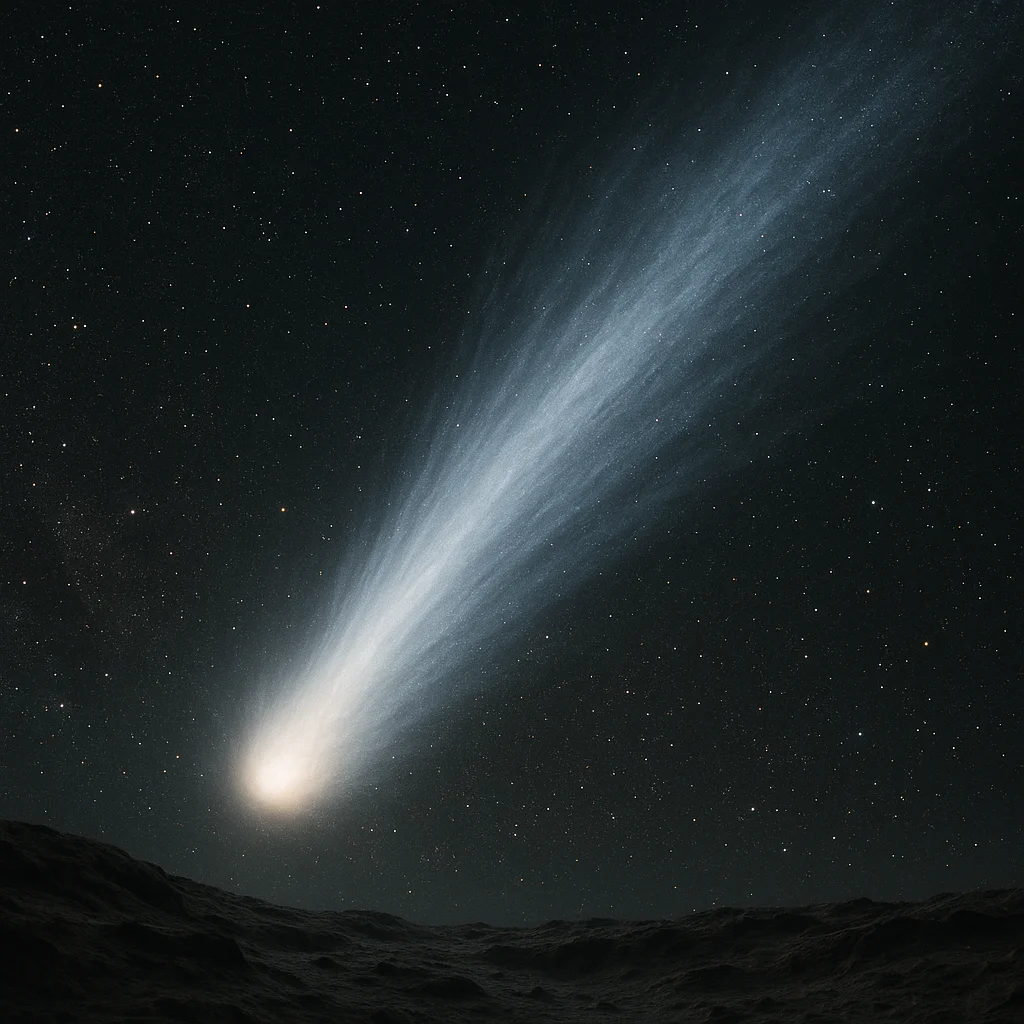
Visualization
When comet 3I/ATLAS swept into view of terrestrial and space-borne observatories in July 2025, it presented astrophysicists with a rare, tangible messenger from beyond our own planetary system—a galactic traveler with origins charted to some of the earliest epochs of the Milky Way. The significance of this object, now recognized as the third confirmed interstellar visitor after ‘Oumuamua (1I/2017 U1) and 2I/Borisov, intensified as spectral signatures from both the James Webb Space Telescope (JWST) and ground-based observations unveiled an isotopic chemistry fundamentally distinct from the comets native to the Solar System.
Hubble first captured visual data when 3I/ATLAS was roughly 446 million kilometers distant from Earth. Yet it was the unprecedented capabilities of Webb’s NIRSpec instrument that provided the exquisitely sensitive chemical forensics necessary for deep origin analysis. In December 2025, as the comet arced away from the warming influence of the Sun, Dr. Martin Cordiner and collaborators exploited this window to analyze its outgassing volatiles. Among their most striking findings was an anomalously high deuterium-to-hydrogen (D/H) ratio in water vapor: (D/H)_3I/ATLAS ≈ 9 × 10^{-4}, an enrichment nearly 30-fold the canonical values measured in Solar System comets (typically (D/H) ≈ 3 × 10^{-5}). Such a ratio unequivocally situates the formation environment of 3I/ATLAS in a domain of extremely low temperatures—substantially colder than the nebular regions that condensed the ices of our own Oort Cloud.
The chronometry of isotope cosmochemistry further unfurled with the measurement of the 13C/12C ratio. Where Solar System materials exhibit 13C/12C ≈ 0.011, spectra from NIRSpec revealed only trace 13C, suggesting the progenitor molecular cloud of 3I/ATLAS was deficient in heavy carbon. Galactic chemical evolution models predict increasing abundances of secondary isotopes (such as 13C and 15N) with successive generations of stars, as these nuclides are synthesized in stellar interiors and released into the interstellar medium via winds and supernovae. The low 13C enrichment, coupled with high D/H, indicates a formation epoch prior to the major cycles of enrichment and mixing that predated the Sun’s birth, in what cosmologists term the ‘cosmic noon’ (redshift z ~ 2), a peak star-formation era approximately 10–12 billion years ago.
Webb’s findings found corroboration in independent measurements led by Cyrielle Opitom at the University of Edinburgh, using the UV-Visual Echelle Spectrograph (UVES) on the ESO Very Large Telescope during a series of observation runs in December 2025. Targeting cyanide (CN) emissions and related volatile carriers, UVES analyses confirmed elevated 15N/14N ratios and reinforced the chemically primitive character of the comet’s ices. The absence of substantial isotopic reprocessing—via mechanisms such as photodissociation or thermal alteration—suggests that 3I/ATLAS remained locked in a cold, dense cloud shielded from the energetic processes that govern molecular cloud evolution in the denser, more active galactic disk.
Examining the chemical inventory of 3I/ATLAS thus offers a rare window into the conditions extant before Solar System formation. The abundance of heavy water (HDO), inferred via high deuterium content, aligns with models where ice accretes in environments shielded from ultraviolet radiation, at kinetic temperatures approaching 10 K or lower. Such conditions favor deuterium fractionation through gas-phase reactions such as:
H_3^+ + HD → H_2D^+ + H_2
and the subsequent incorporation of D-enriched molecules into solid ices. That these signatures persist, unaltered, through ejection from its natal system and interstellar aeons, highlights the exceptional preservation fidelity of such primordial objects.
As Stefanie Milam of NASA’s Goddard Space Flight Center notes, the identification of rare isotopic ratios in objects like 3I/ATLAS expands not just our understanding of galactic chemical evolution but also the potential frequency and diversity of prebiotic environments. While Earth remains the only known locus of biogenesis, each interstellar object sampled acts as a test particle for the prevalence of the chemical prerequisites for life.
The synthesis of data from Cordiner et al. (Nature, 2026) and Opitom et al. (Nature, in press) converges upon a picture of 3I/ATLAS as a molecular relic, forged in the earliest, coldest reaches of the Milky Way, its journey spanning upwards of 12 billion years. In its fleeting encounter with the Sun, 3I/ATLAS offers a fleeting, but profound, glimpse into the physical and chemical processes that shaped the galactic environment experienced by our cosmic ancestors—a frozen messenger from the cosmic dawn.
Hubble first captured visual data when 3I/ATLAS was roughly 446 million kilometers distant from Earth. Yet it was the unprecedented capabilities of Webb’s NIRSpec instrument that provided the exquisitely sensitive chemical forensics necessary for deep origin analysis. In December 2025, as the comet arced away from the warming influence of the Sun, Dr. Martin Cordiner and collaborators exploited this window to analyze its outgassing volatiles. Among their most striking findings was an anomalously high deuterium-to-hydrogen (D/H) ratio in water vapor: (D/H)_3I/ATLAS ≈ 9 × 10^{-4}, an enrichment nearly 30-fold the canonical values measured in Solar System comets (typically (D/H) ≈ 3 × 10^{-5}). Such a ratio unequivocally situates the formation environment of 3I/ATLAS in a domain of extremely low temperatures—substantially colder than the nebular regions that condensed the ices of our own Oort Cloud.
The chronometry of isotope cosmochemistry further unfurled with the measurement of the 13C/12C ratio. Where Solar System materials exhibit 13C/12C ≈ 0.011, spectra from NIRSpec revealed only trace 13C, suggesting the progenitor molecular cloud of 3I/ATLAS was deficient in heavy carbon. Galactic chemical evolution models predict increasing abundances of secondary isotopes (such as 13C and 15N) with successive generations of stars, as these nuclides are synthesized in stellar interiors and released into the interstellar medium via winds and supernovae. The low 13C enrichment, coupled with high D/H, indicates a formation epoch prior to the major cycles of enrichment and mixing that predated the Sun’s birth, in what cosmologists term the ‘cosmic noon’ (redshift z ~ 2), a peak star-formation era approximately 10–12 billion years ago.
Webb’s findings found corroboration in independent measurements led by Cyrielle Opitom at the University of Edinburgh, using the UV-Visual Echelle Spectrograph (UVES) on the ESO Very Large Telescope during a series of observation runs in December 2025. Targeting cyanide (CN) emissions and related volatile carriers, UVES analyses confirmed elevated 15N/14N ratios and reinforced the chemically primitive character of the comet’s ices. The absence of substantial isotopic reprocessing—via mechanisms such as photodissociation or thermal alteration—suggests that 3I/ATLAS remained locked in a cold, dense cloud shielded from the energetic processes that govern molecular cloud evolution in the denser, more active galactic disk.
Examining the chemical inventory of 3I/ATLAS thus offers a rare window into the conditions extant before Solar System formation. The abundance of heavy water (HDO), inferred via high deuterium content, aligns with models where ice accretes in environments shielded from ultraviolet radiation, at kinetic temperatures approaching 10 K or lower. Such conditions favor deuterium fractionation through gas-phase reactions such as:
H_3^+ + HD → H_2D^+ + H_2
and the subsequent incorporation of D-enriched molecules into solid ices. That these signatures persist, unaltered, through ejection from its natal system and interstellar aeons, highlights the exceptional preservation fidelity of such primordial objects.
As Stefanie Milam of NASA’s Goddard Space Flight Center notes, the identification of rare isotopic ratios in objects like 3I/ATLAS expands not just our understanding of galactic chemical evolution but also the potential frequency and diversity of prebiotic environments. While Earth remains the only known locus of biogenesis, each interstellar object sampled acts as a test particle for the prevalence of the chemical prerequisites for life.
The synthesis of data from Cordiner et al. (Nature, 2026) and Opitom et al. (Nature, in press) converges upon a picture of 3I/ATLAS as a molecular relic, forged in the earliest, coldest reaches of the Milky Way, its journey spanning upwards of 12 billion years. In its fleeting encounter with the Sun, 3I/ATLAS offers a fleeting, but profound, glimpse into the physical and chemical processes that shaped the galactic environment experienced by our cosmic ancestors—a frozen messenger from the cosmic dawn.