Field: Technology
Changzhousaurus sinensis: A Four-Winged Enigma Sheds New Light on Early Pennaraptoran Evolution
Published June 25, 2026 | Technical Staff
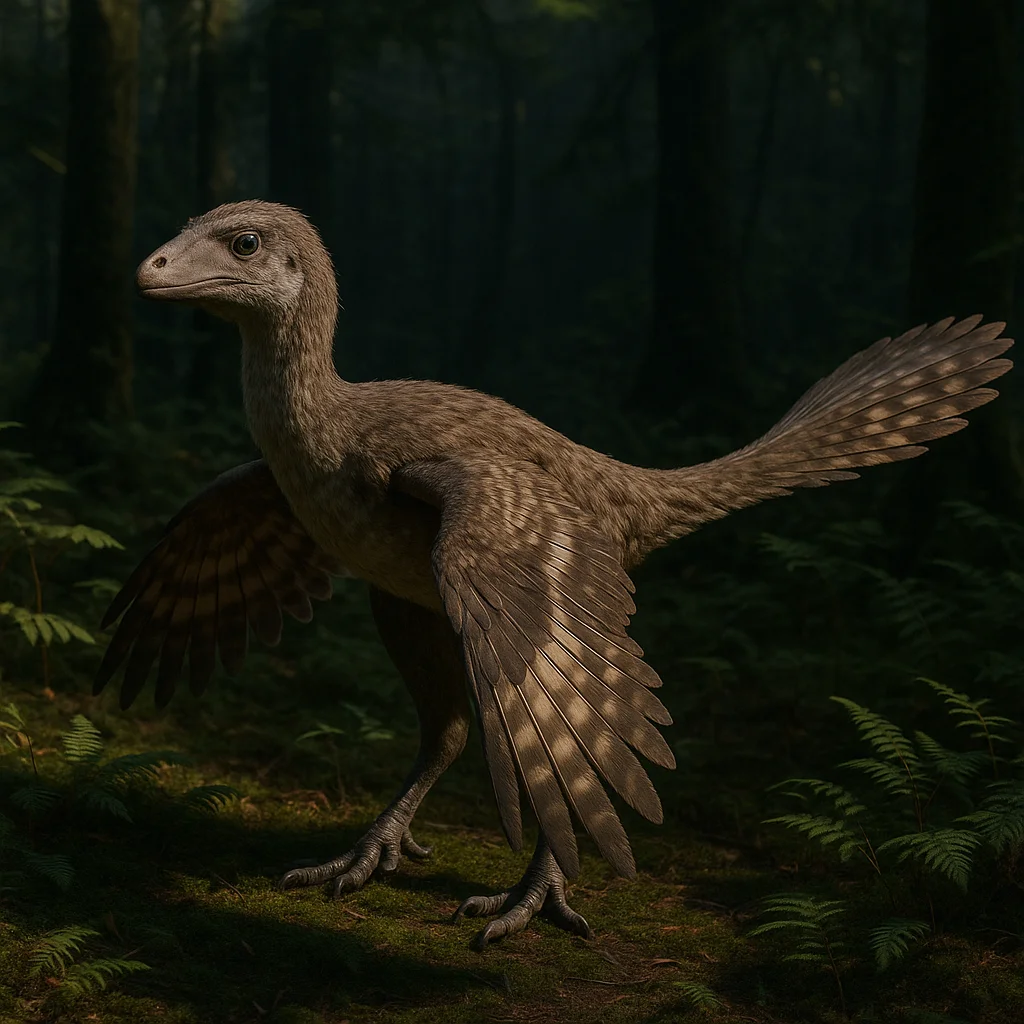
Visualization
From the fossil-rich strata of the Jiufotang Formation in western Liaoning, northern China, paleontologists have unearthed a diminutive but paradigm-shifting dinosaur, Changzhousaurus sinensis, whose remarkable preservation is reshaping the narrative of avian evolution. Dated to approximately 120 million years ago during the Early Cretaceous, this taxon, described by Dr. Xing Xu and colleagues at the Institute of Vertebrate Paleontology and Paleoanthropology of the Chinese Academy of Sciences, exemplifies both mosaic anatomical evolution and the complexities inherent in reconstructing the origins of flight and feathering within the Dinosauria.
Measuring a mere 34 centimeters in total body length — a length that places it decisively among the smallest known non-avian theropods — C. sinensis is not merely an outlier of size, but a case study in evolutionary experimentation. The holotype, represented by a near-complete skeleton including slab and counter slab preservation, revealed not only the bones but also extensive evidence of plumage, offering a window into both morphology and probable life appearance with unprecedented fidelity.
Phylogenetically, Changzhousaurus sinensis emerges as an early-diverging member of Deinonychosauria, within the broader clade Pennaraptora. This latter group, as delineated by Dr. Xu, encompasses both established families such as Oviraptorosauria, Dromaeosauridae, Troodontidae, and Avialae, and a suite of recently defined smaller clades — including Unenlagiinae, Microraptorinae, Scansoriopterygidae, Anchiornithinae, and Halszkaraptorinae. Over the past thirty years, fossils from these groups have collectively filled morphological gaps that once separated major pennaraptoran lineages. Notably, they have extended the record of pennaceous feathers, provided tangible evidence for incipient flight behaviors, and documented a suite of unexpected morphologies and niche adaptations — all testaments to the rapid evolutionary radiation of Pennaraptora during the Middle Jurassic.
Changzhousaurus sinensis is particularly notable for its caudal extravagance: approximately sixteen hyper-elongated tail feathers, each approximately quadruple the length of the femur. These long, vaned plumes closely parallel the ornamental rectrices observed in modern peafowl (Pavo cristatus), suggesting a function potentially rooted in display or sexual selection rather than aerodynamic utility. The relative length ratio (L_feather/L_femur ≈ 4) is without precedent among coeval non-avian pennaraptorans, where tail feather length more typically scales at a 1:1 to 2:1 ratio with femoral length.
The forelimbs of Changzhousaurus are equally revelatory. The primary flight feathers — approximately 12 centimeters in length — proportionally exceed those of other non-avian pennaraptoran contemporaries, with the ratio of feather length to arm length markedly surpassing values observed in taxa such as Microraptor or Anchiornis. This discordance between feathered wing area and absolute arm length challenges prior assumptions that aerofoil and skeletal enlargement followed a tightly coupled evolutionary trajectory. Instead, these data evoke a scenario of modular evolution — whereby structural innovations in feather morphology occasionally outpaced, and perhaps facilitated, subsequent shifts in limb proportions.
Moreover, the fossil preserves robust feathering over both the forelimb and hindlimb extremities, reinforcing the prevalence of four-winged (tetrapterygian) morphotypes among basal pennaraptorans. Such configurations, previously best exemplified by Microraptor gui, broaden the phylogenetic scope of four-winged body plans and further complicate aerodynamic modeling for the origin of flight; specifically, whether gliding or powered flight originated via sequential, piecemeal enhancement of limb plumage, or arose more synchronously across the appendicular skeleton.
Embedded within these spectacular remains are broader questions — and unresolved tensions — underscored by Dr. Xu: What, precisely, constitutes a feather within the evolutionary trajectory from non-avian dinosaur to bird? How robustly can we infer behavioral or ecological attributes, such as flight capability or habitat preference, from osteological and plumage data alone? And crucially, what defines the boundary between bird and non-bird, Avialae and non-Avialae, in light of extensive trait overlap and homoplasy across early-diverging pennaraptorans?
These questions are exemplified by the enigmatic morphology of Changzhousaurus. On one hand, its impressive plumage and wing-construction borrow heavily from avian templates, while its compact size and unique amalgam of deinonychosaurian features root it firmly outside crown Avialae. It is thus both a bridge and a boundary marker — a creature whose complex morphology unsettles old certainties and sharpens focus on the region of the Dinosauria-avian transition still shrouded in ambiguity.
As articulated in Dr. Xu’s publication in Vertebrata PalAsiatica (doi: 10.19615/j.cnki.2096-9899.260616), this new fossil not only exemplifies the mosaic evolution of feathers, wings, and display structures, but also foregrounds conceptual and methodological challenges that lie ahead. Robust phylogenetic resolution, integration of soft-tissue and osteological data, and refined ecological inference will be essential as researchers continue to traverse the tangled branches that connect the roots of Pennaraptora to the emergence of true birds.
Measuring a mere 34 centimeters in total body length — a length that places it decisively among the smallest known non-avian theropods — C. sinensis is not merely an outlier of size, but a case study in evolutionary experimentation. The holotype, represented by a near-complete skeleton including slab and counter slab preservation, revealed not only the bones but also extensive evidence of plumage, offering a window into both morphology and probable life appearance with unprecedented fidelity.
Phylogenetically, Changzhousaurus sinensis emerges as an early-diverging member of Deinonychosauria, within the broader clade Pennaraptora. This latter group, as delineated by Dr. Xu, encompasses both established families such as Oviraptorosauria, Dromaeosauridae, Troodontidae, and Avialae, and a suite of recently defined smaller clades — including Unenlagiinae, Microraptorinae, Scansoriopterygidae, Anchiornithinae, and Halszkaraptorinae. Over the past thirty years, fossils from these groups have collectively filled morphological gaps that once separated major pennaraptoran lineages. Notably, they have extended the record of pennaceous feathers, provided tangible evidence for incipient flight behaviors, and documented a suite of unexpected morphologies and niche adaptations — all testaments to the rapid evolutionary radiation of Pennaraptora during the Middle Jurassic.
Changzhousaurus sinensis is particularly notable for its caudal extravagance: approximately sixteen hyper-elongated tail feathers, each approximately quadruple the length of the femur. These long, vaned plumes closely parallel the ornamental rectrices observed in modern peafowl (Pavo cristatus), suggesting a function potentially rooted in display or sexual selection rather than aerodynamic utility. The relative length ratio (L_feather/L_femur ≈ 4) is without precedent among coeval non-avian pennaraptorans, where tail feather length more typically scales at a 1:1 to 2:1 ratio with femoral length.
The forelimbs of Changzhousaurus are equally revelatory. The primary flight feathers — approximately 12 centimeters in length — proportionally exceed those of other non-avian pennaraptoran contemporaries, with the ratio of feather length to arm length markedly surpassing values observed in taxa such as Microraptor or Anchiornis. This discordance between feathered wing area and absolute arm length challenges prior assumptions that aerofoil and skeletal enlargement followed a tightly coupled evolutionary trajectory. Instead, these data evoke a scenario of modular evolution — whereby structural innovations in feather morphology occasionally outpaced, and perhaps facilitated, subsequent shifts in limb proportions.
Moreover, the fossil preserves robust feathering over both the forelimb and hindlimb extremities, reinforcing the prevalence of four-winged (tetrapterygian) morphotypes among basal pennaraptorans. Such configurations, previously best exemplified by Microraptor gui, broaden the phylogenetic scope of four-winged body plans and further complicate aerodynamic modeling for the origin of flight; specifically, whether gliding or powered flight originated via sequential, piecemeal enhancement of limb plumage, or arose more synchronously across the appendicular skeleton.
Embedded within these spectacular remains are broader questions — and unresolved tensions — underscored by Dr. Xu: What, precisely, constitutes a feather within the evolutionary trajectory from non-avian dinosaur to bird? How robustly can we infer behavioral or ecological attributes, such as flight capability or habitat preference, from osteological and plumage data alone? And crucially, what defines the boundary between bird and non-bird, Avialae and non-Avialae, in light of extensive trait overlap and homoplasy across early-diverging pennaraptorans?
These questions are exemplified by the enigmatic morphology of Changzhousaurus. On one hand, its impressive plumage and wing-construction borrow heavily from avian templates, while its compact size and unique amalgam of deinonychosaurian features root it firmly outside crown Avialae. It is thus both a bridge and a boundary marker — a creature whose complex morphology unsettles old certainties and sharpens focus on the region of the Dinosauria-avian transition still shrouded in ambiguity.
As articulated in Dr. Xu’s publication in Vertebrata PalAsiatica (doi: 10.19615/j.cnki.2096-9899.260616), this new fossil not only exemplifies the mosaic evolution of feathers, wings, and display structures, but also foregrounds conceptual and methodological challenges that lie ahead. Robust phylogenetic resolution, integration of soft-tissue and osteological data, and refined ecological inference will be essential as researchers continue to traverse the tangled branches that connect the roots of Pennaraptora to the emergence of true birds.