Field: Technology
Early Fire Use by Homo Erectus at Wonderwerk Cave Pushes Back Pyrotechnic Origins to 1.8 Million Years
Published June 17, 2026 | Technical Staff
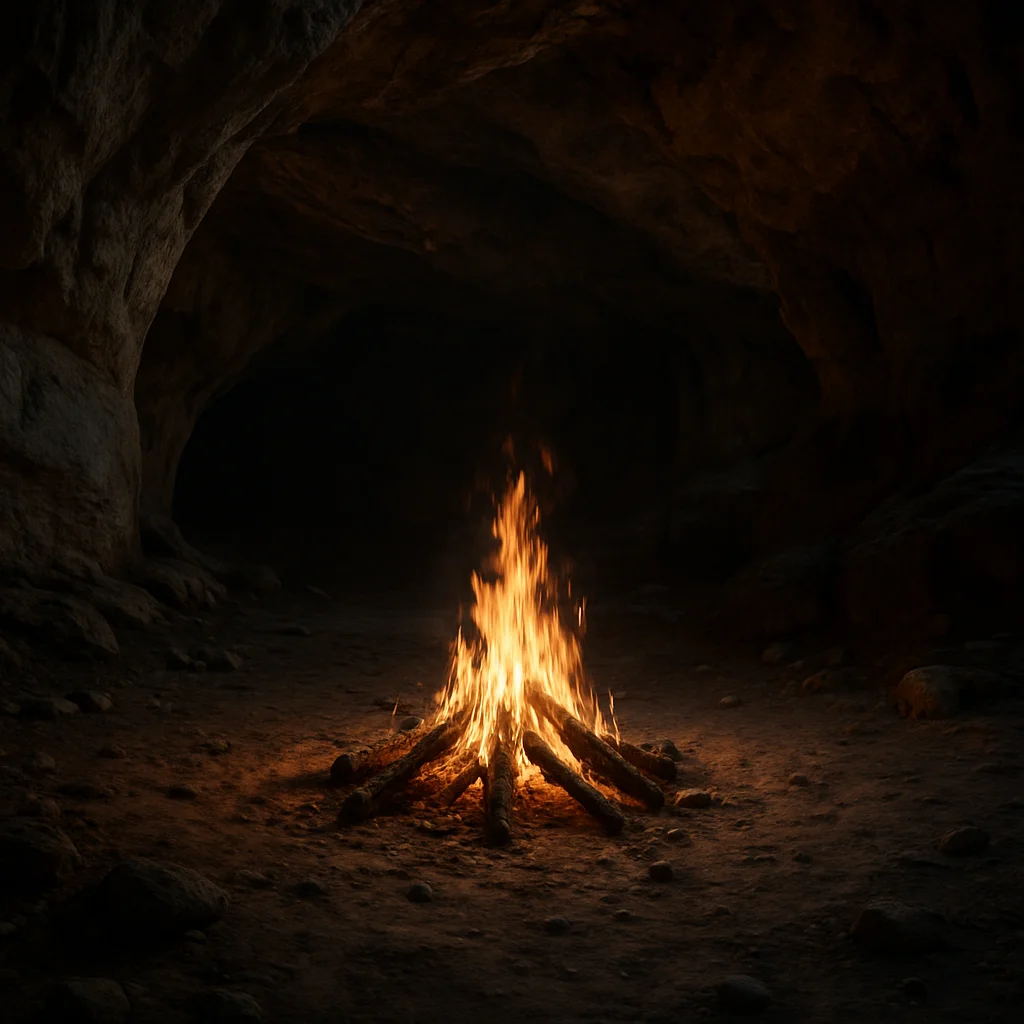
Visualization
The evolutionary timeline of human–fire interaction has been dramatically redrafted with the emergence of new data from Wonderwerk Cave, an archaeological crucible set in South Africa’s arid Northern Cape. A recent investigation led by Dr. Liora Kolska Horwitz (Hebrew University of Jerusalem) and her multidisciplinary cohort presents robust evidence that early hominins—most plausibly Homo erectus—actively introduced fire into this limestone cavern as early as 1.79 million years before present. This discovery, published in *PLOS ONE* (Marin-Monfort et al., 2026), leverages advanced luminescence and geochemical techniques to upend prevailing models of prehistoric pyrotechnology.
Wonderwerk Cave, situated 60 kilometers south of Kuruman, preserves an unbroken stratigraphic record spanning nearly two million years. Excavations in this natural archive have previously extended the documented chronology of fire use to circa one million years ago, correlating burned faunal remains with Middle Pleistocene Acheulean assemblages. However, Dr. Horwitz and colleagues have now traced thermogenic evidence substantially deeper—both stratigraphically and temporally—into the early Acheulean, within deposits dated securely between 1.07 and 1.79 million years ago.
Central to these findings is an analytical protocol marrying non-destructive photoluminescence assays with established chemical probes. When fossil bones from various stratigraphic contexts are irradiated with select wavelengths, those subjected to high temperatures (>400°C) emit a distinct luminescent signal—an empirical fingerprint of burning not confounded by mineral alteration or diagenesis. The team validated this technique against experimental burn series and paired their photoluminescent data with pyrolytic transformation products (such as elevated ratios of thermally altered carbonate to phosphate in bone matrix, detected via FTIR spectroscopy). This multi-modal evidence confirmed the anthropogenic combustion signature on faunal elements closely associated in situ with Acheulean lithic artifacts.
Crucially, the context of these burned remains undermines taphonomic alternatives. The absence of any sedimentological indication for allochthonous deposition (e.g., flooding or animal scavenging) and the spatial congruence of charred bones with undisturbed archaeological horizons argue against abiotic wildfire sweepings or bioturbation as agents of transport. Rather, the data implicate hominins in the deliberate introduction and maintenance of exogenous fire within the cave—an adaptive strategy that falls between opportunistic scavenging of natural wildfire and later, technologically mediated fire production.
This behavioral nuance is fundamental: While the capacity to *produce* fire (via friction or percussion) is inferred only from much later Paleolithic sites, exploitation of wildfires demands a different cognitive and social toolkit. Early Homo likely procured embers from landscapes seasonally punctuated by lightning-induced fires, transporting and sustaining them in sheltered locations such as Wonderwerk. The calculated maintenance—rather than mere opportunistic exposure—to fire suggests a pivotal shift in hominin ecological agency, presaging new dietary strategies, predator deterrence, and perhaps even social organization around the hearth.
The implications of this find are profound for the broader discourse on human evolution. Fire use is understood as a transformative vector in the genus Homo, facilitating encephalization via caloric enhancement of cooked foods (cf. Wrangham’s “cooking hypothesis”), modifying circadian rhythms, and enabling geographic expansions into temperate latitudes. The Wonderwerk findings compress the temporal gap between the emergence of early Homo and complex fire management by nearly 800,000 years, pushing the inception of fire culture to the very roots of Acheulean technology.
As research methodologies in archaeometry grow increasingly precise, the picture of early fire use is becoming less a matter of speculative inference and more one of empirical certitude. The Wonderwerk Cave specimens—irradiated in the lab but charred in antiquity—illuminate a dawn when our forebears first glimpsed, grasped, and harnessed the burning edge of evolution.
Wonderwerk Cave, situated 60 kilometers south of Kuruman, preserves an unbroken stratigraphic record spanning nearly two million years. Excavations in this natural archive have previously extended the documented chronology of fire use to circa one million years ago, correlating burned faunal remains with Middle Pleistocene Acheulean assemblages. However, Dr. Horwitz and colleagues have now traced thermogenic evidence substantially deeper—both stratigraphically and temporally—into the early Acheulean, within deposits dated securely between 1.07 and 1.79 million years ago.
Central to these findings is an analytical protocol marrying non-destructive photoluminescence assays with established chemical probes. When fossil bones from various stratigraphic contexts are irradiated with select wavelengths, those subjected to high temperatures (>400°C) emit a distinct luminescent signal—an empirical fingerprint of burning not confounded by mineral alteration or diagenesis. The team validated this technique against experimental burn series and paired their photoluminescent data with pyrolytic transformation products (such as elevated ratios of thermally altered carbonate to phosphate in bone matrix, detected via FTIR spectroscopy). This multi-modal evidence confirmed the anthropogenic combustion signature on faunal elements closely associated in situ with Acheulean lithic artifacts.
Crucially, the context of these burned remains undermines taphonomic alternatives. The absence of any sedimentological indication for allochthonous deposition (e.g., flooding or animal scavenging) and the spatial congruence of charred bones with undisturbed archaeological horizons argue against abiotic wildfire sweepings or bioturbation as agents of transport. Rather, the data implicate hominins in the deliberate introduction and maintenance of exogenous fire within the cave—an adaptive strategy that falls between opportunistic scavenging of natural wildfire and later, technologically mediated fire production.
This behavioral nuance is fundamental: While the capacity to *produce* fire (via friction or percussion) is inferred only from much later Paleolithic sites, exploitation of wildfires demands a different cognitive and social toolkit. Early Homo likely procured embers from landscapes seasonally punctuated by lightning-induced fires, transporting and sustaining them in sheltered locations such as Wonderwerk. The calculated maintenance—rather than mere opportunistic exposure—to fire suggests a pivotal shift in hominin ecological agency, presaging new dietary strategies, predator deterrence, and perhaps even social organization around the hearth.
The implications of this find are profound for the broader discourse on human evolution. Fire use is understood as a transformative vector in the genus Homo, facilitating encephalization via caloric enhancement of cooked foods (cf. Wrangham’s “cooking hypothesis”), modifying circadian rhythms, and enabling geographic expansions into temperate latitudes. The Wonderwerk findings compress the temporal gap between the emergence of early Homo and complex fire management by nearly 800,000 years, pushing the inception of fire culture to the very roots of Acheulean technology.
As research methodologies in archaeometry grow increasingly precise, the picture of early fire use is becoming less a matter of speculative inference and more one of empirical certitude. The Wonderwerk Cave specimens—irradiated in the lab but charred in antiquity—illuminate a dawn when our forebears first glimpsed, grasped, and harnessed the burning edge of evolution.