Field: Technology
Newly Discovered Walking Shark Sheds Light on Evolutionary Isolation in Reef Ecosystems
Published June 17, 2026 | Technical Staff
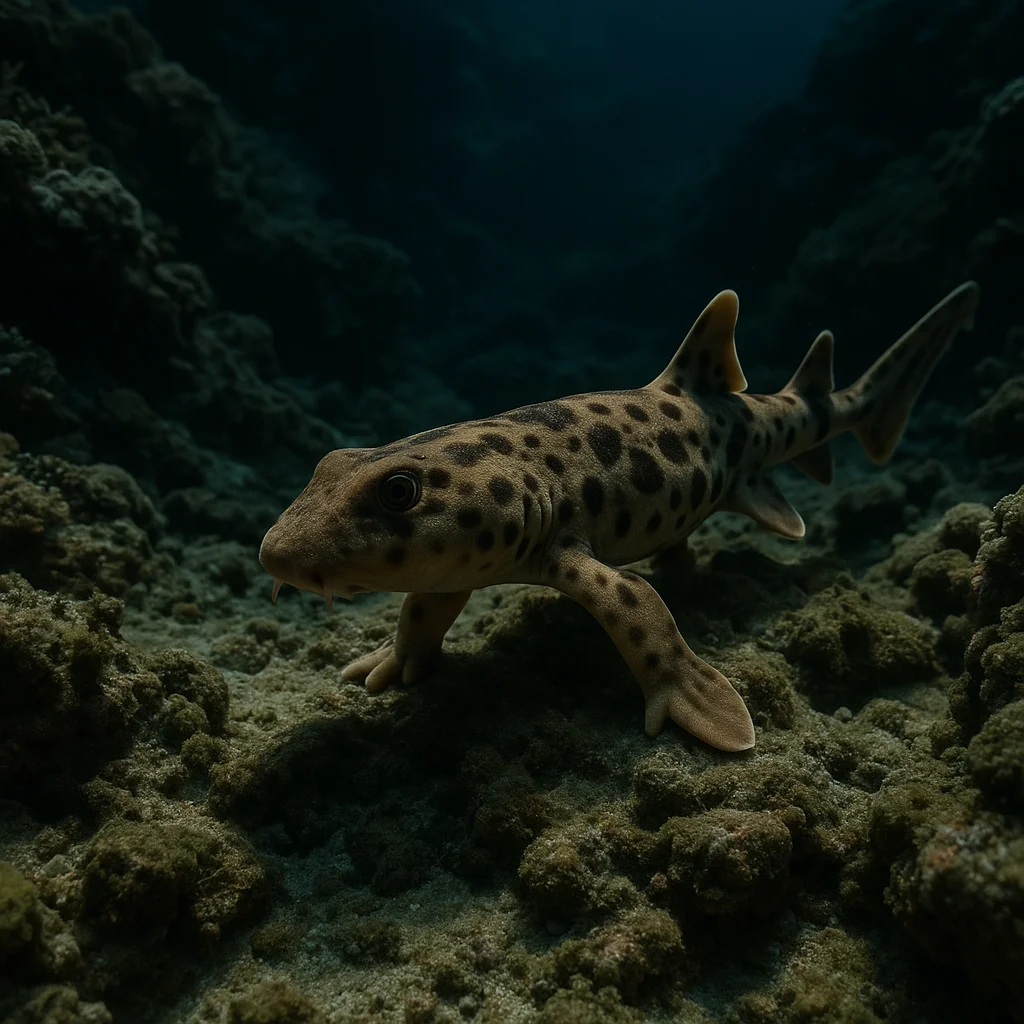
Visualization
Amid the coral labyrinths and mangrove mazes off the eastern coast of Papua New Guinea, marine biologists have illuminated the existence of a new species in one of the planet’s most unusual vertebrate groups: the walking sharks of the genus *Hemiscyllium*. This latest addition—*Hemiscyllium dudgeonae*, or Dudgeon’s epaulette shark—not only augments the growing catalog of these benthic, nocturnal predators but significantly refines our understanding of biogeographical partitioning and evolutionary processes among Indo-Pacific reef ecosystems.
Virtually the only sharks capable of “walking” across the seafloor, *Hemiscyllium* spp. use their paired pectoral and pelvic fins in a coordinated, alternate-gait-like locomotion. These adaptations permit them to navigate complex substrates where swimming is inefficient, offering a rare window into convergent evolution among elasmobranchs with respect to arboreal or terrestrial analogues. Dudgeon’s epaulette shark, now the tenth recognized species within the genus, was delineated through meticulous morphological and molecular scrutiny of specimens collected during 2023–2025 field surveys in Milne Bay Province—an area that, due to its archipelagic structure and unique paleogeographical history, represents a classic zone of microendemism.
Morphologically, *H. dudgeonae* exhibits a distinct phenotypic suite. Along its dorso-lateral surfaces, a constellation of brown freckles disrupted by sporadic white spots and dashes defines its cryptic palette, while a pronounced ocellus, or eye-like marking, is situated posterior to its cephalic region—a likely aposematic device in predator deterrence. These external markers, underpinned by a mitochondrial cytochrome oxidase I (COI) barcoding approach, enabled resolution of *H. dudgeonae* as a discrete taxon most closely allied to *H. michaeli*, yet unequivocally genetically and geographically divergent. Sequence divergence assessed via Kimura-2-parameter (K2P) genetic distances exceeded the interspecific threshold (>2% divergence) typically used for elasmobranch delineation.
Measuring up to 80 cm in total length—though a conspecific elsewhere in the genus reportedly attains 107 cm—*H. dudgeonae* embodies the generalized littoral habitat occupation of Hemiscyllids. Predominantly benthic and nocturnal, these sharks inhabit coral reefs, seagrass beds, and mangrove shallows, occupying ecological niches less than 10 m in depth, yet occasionally recorded to 50 m. Their oviparity, with females attaching leathery, oval egg capsules to substrate, underscores a life-history strategy that fosters high site fidelity—and, paradoxically, extreme vulnerability. Home range estimations for *Hemiscyllium* spp. rarely exceed several square kilometers; dispersal is limited by both behavioral and developmental constraints, a fact that renders these microendemic taxa particularly sensitive to local habitat perturbation.
The revelation of *H. dudgeonae* arrives at a critical juncture for the conservation of carpet sharks (family Hemiscylliidae), whose distributions along the Sahul Shelf and Melanesian archipelago reflect a mosaic of historic sea-level fluctuations, land-bridge connections, and oceanographic barriers. Classic paradigms had postulated that major biogeographical boundaries—such as riverine outflows or deep-water channels—served as effective filters maintaining allopatric separation among walking shark species. However, the team led by Dr. Christine Dudgeon of the University of the Sunshine Coast, by updating the documented ranges of both *H. michaeli* and *H. hallstromi* alongside their description of the new taxon, demonstrated overlapping distributions in eastern Papua New Guinea. Surprisingly, fine-scale sympatry was not observed: while habitats abutted, no co-occurrence at microhabitat scale was recorded, hinting at nuanced competitive or reproductive partitioning yet to be fully elucidated.
These findings are not merely academic. Of the ten known Papua New Guinean epaulette sharks, five are currently listed as ‘Threatened with Extinction’ under the IUCN Red List criterion B—a spatial restriction metric that applies to just 3% of all shark species. Early evidence suggests that *H. dudgeonae*, limited to a geographically narrow tract of reef, is especially susceptible to anthropogenic pressures including overfishing, coral mining, and habitat degradation. Pending further population and range data, the authors urge consideration of Vulnerable or Endangered status for the species, with additional fieldwork slated for late 2025.
Published by J.-A. Blakeway and colleagues in the *Journal of the Ocean Science Foundation* (Vol. 46:71-110; doi: 10.5281/zenodo.20575429), this taxonomic revision and descriptive account not only spotlight the urgent need for increased conservation focus on restricted-range elasmobranchs, but also offer potent reminders of the evolutionary complexity harbored in understudied Indo-Pacific reefs. As ongoing research uses integrative taxonomy and ecological modeling, the walking sharks of New Guinea may yet yield unprecedented insight into the twin forces of isolation and adaptation that drive speciation in marine systems.
Virtually the only sharks capable of “walking” across the seafloor, *Hemiscyllium* spp. use their paired pectoral and pelvic fins in a coordinated, alternate-gait-like locomotion. These adaptations permit them to navigate complex substrates where swimming is inefficient, offering a rare window into convergent evolution among elasmobranchs with respect to arboreal or terrestrial analogues. Dudgeon’s epaulette shark, now the tenth recognized species within the genus, was delineated through meticulous morphological and molecular scrutiny of specimens collected during 2023–2025 field surveys in Milne Bay Province—an area that, due to its archipelagic structure and unique paleogeographical history, represents a classic zone of microendemism.
Morphologically, *H. dudgeonae* exhibits a distinct phenotypic suite. Along its dorso-lateral surfaces, a constellation of brown freckles disrupted by sporadic white spots and dashes defines its cryptic palette, while a pronounced ocellus, or eye-like marking, is situated posterior to its cephalic region—a likely aposematic device in predator deterrence. These external markers, underpinned by a mitochondrial cytochrome oxidase I (COI) barcoding approach, enabled resolution of *H. dudgeonae* as a discrete taxon most closely allied to *H. michaeli*, yet unequivocally genetically and geographically divergent. Sequence divergence assessed via Kimura-2-parameter (K2P) genetic distances exceeded the interspecific threshold (>2% divergence) typically used for elasmobranch delineation.
Measuring up to 80 cm in total length—though a conspecific elsewhere in the genus reportedly attains 107 cm—*H. dudgeonae* embodies the generalized littoral habitat occupation of Hemiscyllids. Predominantly benthic and nocturnal, these sharks inhabit coral reefs, seagrass beds, and mangrove shallows, occupying ecological niches less than 10 m in depth, yet occasionally recorded to 50 m. Their oviparity, with females attaching leathery, oval egg capsules to substrate, underscores a life-history strategy that fosters high site fidelity—and, paradoxically, extreme vulnerability. Home range estimations for *Hemiscyllium* spp. rarely exceed several square kilometers; dispersal is limited by both behavioral and developmental constraints, a fact that renders these microendemic taxa particularly sensitive to local habitat perturbation.
The revelation of *H. dudgeonae* arrives at a critical juncture for the conservation of carpet sharks (family Hemiscylliidae), whose distributions along the Sahul Shelf and Melanesian archipelago reflect a mosaic of historic sea-level fluctuations, land-bridge connections, and oceanographic barriers. Classic paradigms had postulated that major biogeographical boundaries—such as riverine outflows or deep-water channels—served as effective filters maintaining allopatric separation among walking shark species. However, the team led by Dr. Christine Dudgeon of the University of the Sunshine Coast, by updating the documented ranges of both *H. michaeli* and *H. hallstromi* alongside their description of the new taxon, demonstrated overlapping distributions in eastern Papua New Guinea. Surprisingly, fine-scale sympatry was not observed: while habitats abutted, no co-occurrence at microhabitat scale was recorded, hinting at nuanced competitive or reproductive partitioning yet to be fully elucidated.
These findings are not merely academic. Of the ten known Papua New Guinean epaulette sharks, five are currently listed as ‘Threatened with Extinction’ under the IUCN Red List criterion B—a spatial restriction metric that applies to just 3% of all shark species. Early evidence suggests that *H. dudgeonae*, limited to a geographically narrow tract of reef, is especially susceptible to anthropogenic pressures including overfishing, coral mining, and habitat degradation. Pending further population and range data, the authors urge consideration of Vulnerable or Endangered status for the species, with additional fieldwork slated for late 2025.
Published by J.-A. Blakeway and colleagues in the *Journal of the Ocean Science Foundation* (Vol. 46:71-110; doi: 10.5281/zenodo.20575429), this taxonomic revision and descriptive account not only spotlight the urgent need for increased conservation focus on restricted-range elasmobranchs, but also offer potent reminders of the evolutionary complexity harbored in understudied Indo-Pacific reefs. As ongoing research uses integrative taxonomy and ecological modeling, the walking sharks of New Guinea may yet yield unprecedented insight into the twin forces of isolation and adaptation that drive speciation in marine systems.