Field: Technology
Rewriting the Impact Record: The North Pole Dome Crater Pushes Earth’s Cataclysmic History Back 3 Billion Years
Published June 25, 2026 | Technical Staff
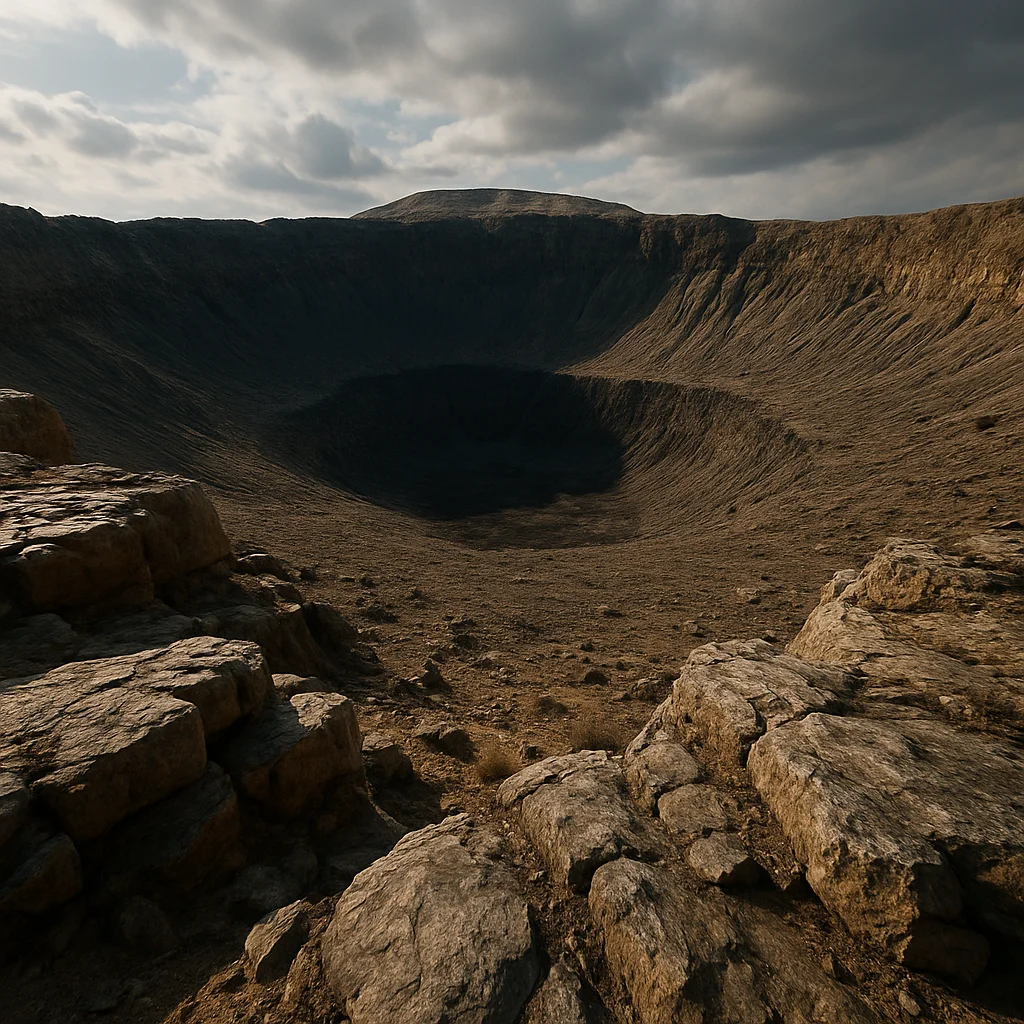
Visualization
Deep in the heart of Western Australia’s Pilbara region, the North Pole Dome has long been a geological enigma—a silent witness to Earth's most profound, but elusive, cataclysms. Recent research by Curtin University’s Professor Chris Kirkland and collaborators has now catapulted this formation to global prominence, establishing it as the oldest dated and only confirmed Archean-age impact structure on the planet. This revelation pushes the terrestrial impact record into an era previously considered nearly inaccessible to direct evidence, opening an extraordinary window onto the violent processes that forged the primordial Earth.
The Moon’s ancient highlands have preserved the scars of planetary bombardment with crystalline clarity, yet on Earth, comparable evidence from the Hadean and early Archean eons is almost entirely effaced by relentless tectonics, metamorphism, and hydrothermal alteration. Impact structures, especially those embedded in Archean terranes dominated by mafic protoliths, rarely retain the mineralogical signatures essential for dating: quartz, which manifests diagnostic shock metamorphism, and zircon (ZrSiO₄), a paragon of geochronological resilience. This makes any credible claim of early impact heritage not only technically challenging but of profound scientific consequence.
The North Pole Dome, situated at the nexus of the East Pilbara Terrane—a mosaic of Paleoarchean granite domes circumscribed by greenstone belts—first entered the impact debate with the discovery of a dense field of shatter cones. These structures, unmistakable macroscale indicators of hypervelocity impact, were initially ascribed an age of approximately 3.47 Ga, but later uncertainty arose as shatter cones were identified in lithologies correlating with the Neoarchean Mount Roe Basalt, suggesting the possibility of a much younger event (2.7–0.4 Ga). Resolving this chronostratigraphic conundrum would require advances in both sampling and analytical precision.
Kirkland’s team approached the problem by targeting two petrologically distinct, shatter-cone-bearing lithologies: a zirconiferous metadolerite and an apatite-rich metabasalt, along with a vein of shocked quartz-calcite intersecting shatter cone surfaces. These samples were subjected to advanced U-Pb isotope geochronology, leveraging the unique thermodynamic behavior of zircon under transient high-temperature shock.
Within the metadolerite, zircon grains displayed intricate morphologies: branching, skeletal forms—so-called “impact-modified” crystals—interpreted as evidence of partial recrystallization and episodic neocrystallization during impact-induced metamorphism. Analytical data revealed that these zircons recorded a Pb/U reset at ca. 3.0 Ga, an age now resolved as the temporal marker of the impact. This “mineral clock” effect arises from the fundamental mechanics of zircon: under intense impact heating, the crystal structure rearranges, expelling radiogenic lead and enabling the growth of new zircon domains, all of which are amenable to high-precision isotopic dating.
To substantiate this result, the team applied (U-Th)/He and U-Pb geochronology to apatite within the shock-metamorphosed metabasalt. Apatite, susceptible to dissolution–precipitation dynamics in hydrothermal fluids mobilized by impact, independently registered the same event: an age indistinguishable within analytical uncertainty from the zircon-derived date. The concordance between these two mineral systems—one robust at extreme temperatures, the other sensitive to hydrothermal events—constitutes compelling evidence for the impact’s timing.
This geochronological dual confirmation not only pins down the North Pole Dome’s impact event at ca. 3.0 Ga but effectively rewrites the cratering record of our planet. It demonstrates that, despite pervasive Archean alteration, vestiges of the planet’s tumultuous formative eons can be coaxed from the mineral archive with sufficiently sophisticated methodology.
Ancient impact craters are notoriously recalcitrant to direct dating, their petrological and isotopic histories overprinted by eons of tectonothermal overprinting, metasomatism, and weathering. Kirkland and colleagues’ success in “separating the moment of impact from its long geological history” thus marks a methodological leap, one that may unlock further hidden chapters of Earth’s early bombardment.
This finding expands the temporal dimension of Earth’s confirmed impact record, offering a tangible, datable imprint of bolide trauma during the Archean Eon, when the planet’s earliest continental nuclei—the cratons—were emerging. Such events may have profoundly influenced crustal evolution, atmosphere-hydrosphere interactions, and even the earliest vestiges of habitability. As the North Pole Dome stands as a testament to these ancient cataclysms, it invites new scrutiny of Earth's primordial epochs—and promises fresh insights into the chaotic dawn from which the modern planet emerged.
Reference:
Kirkland, C. L. et al. "How old is the North Pole Dome impact, Western Australia?" Geology, published online June 23, 2026; doi: 10.1130/G54866.1
The Moon’s ancient highlands have preserved the scars of planetary bombardment with crystalline clarity, yet on Earth, comparable evidence from the Hadean and early Archean eons is almost entirely effaced by relentless tectonics, metamorphism, and hydrothermal alteration. Impact structures, especially those embedded in Archean terranes dominated by mafic protoliths, rarely retain the mineralogical signatures essential for dating: quartz, which manifests diagnostic shock metamorphism, and zircon (ZrSiO₄), a paragon of geochronological resilience. This makes any credible claim of early impact heritage not only technically challenging but of profound scientific consequence.
The North Pole Dome, situated at the nexus of the East Pilbara Terrane—a mosaic of Paleoarchean granite domes circumscribed by greenstone belts—first entered the impact debate with the discovery of a dense field of shatter cones. These structures, unmistakable macroscale indicators of hypervelocity impact, were initially ascribed an age of approximately 3.47 Ga, but later uncertainty arose as shatter cones were identified in lithologies correlating with the Neoarchean Mount Roe Basalt, suggesting the possibility of a much younger event (2.7–0.4 Ga). Resolving this chronostratigraphic conundrum would require advances in both sampling and analytical precision.
Kirkland’s team approached the problem by targeting two petrologically distinct, shatter-cone-bearing lithologies: a zirconiferous metadolerite and an apatite-rich metabasalt, along with a vein of shocked quartz-calcite intersecting shatter cone surfaces. These samples were subjected to advanced U-Pb isotope geochronology, leveraging the unique thermodynamic behavior of zircon under transient high-temperature shock.
Within the metadolerite, zircon grains displayed intricate morphologies: branching, skeletal forms—so-called “impact-modified” crystals—interpreted as evidence of partial recrystallization and episodic neocrystallization during impact-induced metamorphism. Analytical data revealed that these zircons recorded a Pb/U reset at ca. 3.0 Ga, an age now resolved as the temporal marker of the impact. This “mineral clock” effect arises from the fundamental mechanics of zircon: under intense impact heating, the crystal structure rearranges, expelling radiogenic lead and enabling the growth of new zircon domains, all of which are amenable to high-precision isotopic dating.
To substantiate this result, the team applied (U-Th)/He and U-Pb geochronology to apatite within the shock-metamorphosed metabasalt. Apatite, susceptible to dissolution–precipitation dynamics in hydrothermal fluids mobilized by impact, independently registered the same event: an age indistinguishable within analytical uncertainty from the zircon-derived date. The concordance between these two mineral systems—one robust at extreme temperatures, the other sensitive to hydrothermal events—constitutes compelling evidence for the impact’s timing.
This geochronological dual confirmation not only pins down the North Pole Dome’s impact event at ca. 3.0 Ga but effectively rewrites the cratering record of our planet. It demonstrates that, despite pervasive Archean alteration, vestiges of the planet’s tumultuous formative eons can be coaxed from the mineral archive with sufficiently sophisticated methodology.
Ancient impact craters are notoriously recalcitrant to direct dating, their petrological and isotopic histories overprinted by eons of tectonothermal overprinting, metasomatism, and weathering. Kirkland and colleagues’ success in “separating the moment of impact from its long geological history” thus marks a methodological leap, one that may unlock further hidden chapters of Earth’s early bombardment.
This finding expands the temporal dimension of Earth’s confirmed impact record, offering a tangible, datable imprint of bolide trauma during the Archean Eon, when the planet’s earliest continental nuclei—the cratons—were emerging. Such events may have profoundly influenced crustal evolution, atmosphere-hydrosphere interactions, and even the earliest vestiges of habitability. As the North Pole Dome stands as a testament to these ancient cataclysms, it invites new scrutiny of Earth's primordial epochs—and promises fresh insights into the chaotic dawn from which the modern planet emerged.
Reference:
Kirkland, C. L. et al. "How old is the North Pole Dome impact, Western Australia?" Geology, published online June 23, 2026; doi: 10.1130/G54866.1