Field: Technology
Thirteen Fossil Teeth Illuminate Evolutionary Pathways of Gigantopithecus blacki Across a Turbulent Pleistocene
Published June 17, 2026 | Technical Staff
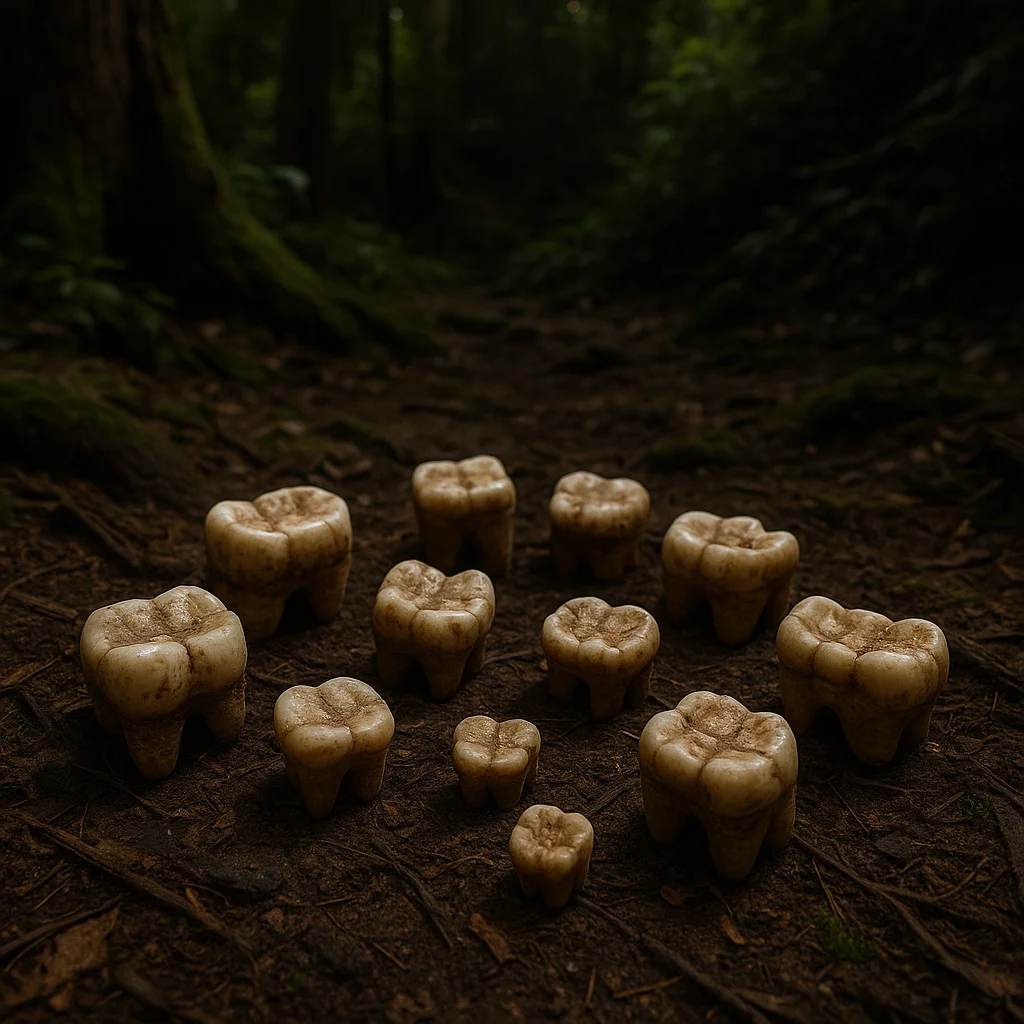
Visualization
In the shadowy depths of Yanli Cave 1, nestled within the limestone matrix of Guangxi province, a discovery has emerged that recalibrates our temporal understanding of *Gigantopithecus blacki*—the largest primate ever to have roamed the Earth. Paleontologists, led by Dr. Yanyan Yao from Shandong University and collaborating institutions, have meticulously unearthed and analyzed thirteen remarkably well-preserved dental fossils—canines, premolars, and molars from both upper and lower jaws—offering a rare Pleistocene snapshot that bridges a critical lacuna in the species’ evolutionary record.
Standing up to 3 meters in height and weighing as much as 540 kilograms, *Gigantopithecus blacki* dwarfed extant great apes and was first described by anthropologist Gustav von Koenigswald in 1935 on the basis of a solitary tooth. Thousands of subsequent dental fossils, along with fragmented mandibles, have since shaped our image of this enigmatic giant, whose range during the Pleistocene spanned the dense forest mosaics of Southeast Asia. Yet, despite the abundance of these dental remnants, the fossil record has been skewed: most specimens cluster in stratigraphic zones demarcated as either Early or Middle Pleistocene, leaving the crucial Early-Middle Pleistocene transition (EMPT, ~1.2 to 0.7 Ma) obscure.
The stratigraphic and faunal context provided by Yanli Cave 1 proves transformative. While the dental specimens themselves could not be radiometrically dated, the surrounding paleofauna permit robust biochronological constraints. Among thirty vertebrate species spanning six mammalian orders, two taxa—*Ailuropoda wulingshanensis* (the late Early Pleistocene giant panda) and *Ailuropoda melanoleuca baconi* (a Middle Pleistocene panda subspecies)—function as temporal markers, their co-occurrence unequivocally situating the deposit within the EMPT. The convergence of these taxa tightens the margin of error for the site's chronology, eliminating ambiguities that often plague isolated fossil discoveries.
Examination of the *Gigantopithecus* teeth reveals a tantalizing mosaic of phenotypic traits. Metric analysis shows that several teeth display the diminutive size profile characteristic of earlier Pleistocene populations, while others exhibit a pronounced increase in crown dimensions—a trend correlating with specimens from younger, Middle Pleistocene assemblages. This gradient in dental morphology supports a scenario wherein *Gigantopithecus blacki* was undergoing an adaptive response, possibly driven by dietary exigencies imposed by fluctuating Pleistocene climates.
The environmental backdrop to this evolutionary inflection was far from static. The EMPT is defined by increasingly severe glacial-interglacial cycling, ushering in cooler and more arid conditions with amplified environmental variability. Such perturbations would have exerted selective pressure on primates dependent on forest resources, with dental robustness and size serving as proxies for dietary flexibility—larger teeth inferring a shift toward harder or more fibrous vegetal material as C_3 forest cover contracted.
The data from Yanli Cave 1 thus functionally anchor *Gigantopithecus blacki* within the context of rapid paleoenvironmental flux. By integrating these discoveries with comparable finds from Queque Cave and Zhanwang Cave—both likewise situated in Chongzuo—researchers now delineate a lineage in transition, one that traces the paleobiological repercussions of the EMPT in unprecedented anatomical detail.
The implications reverberate beyond mere chronology. The Yanli Cave 1 assemblage catalyzes a re-examination of how extreme climate oscillations can induce punctuated episodes of dental evolution and, by extension, population-level adaptive strategies among megafaunal primates. Given the estimated terminal extinction interval of *Gigantopithecus blacki* (295,000–215,000 years ago), understanding these microevolutionary rhythms is pivotal for reconstructing the dynamics that precipitated the demise of the Pleistocene’s most colossal ape.
Published in *Acta Anthropologica Sinica*, these findings offer a crucial biostratigraphic datum, refining our model of Pleistocene faunal turnover while illuminating the intricate interplay between climate, paleobiology, and extinction risk in the great apes of prehistory.
Standing up to 3 meters in height and weighing as much as 540 kilograms, *Gigantopithecus blacki* dwarfed extant great apes and was first described by anthropologist Gustav von Koenigswald in 1935 on the basis of a solitary tooth. Thousands of subsequent dental fossils, along with fragmented mandibles, have since shaped our image of this enigmatic giant, whose range during the Pleistocene spanned the dense forest mosaics of Southeast Asia. Yet, despite the abundance of these dental remnants, the fossil record has been skewed: most specimens cluster in stratigraphic zones demarcated as either Early or Middle Pleistocene, leaving the crucial Early-Middle Pleistocene transition (EMPT, ~1.2 to 0.7 Ma) obscure.
The stratigraphic and faunal context provided by Yanli Cave 1 proves transformative. While the dental specimens themselves could not be radiometrically dated, the surrounding paleofauna permit robust biochronological constraints. Among thirty vertebrate species spanning six mammalian orders, two taxa—*Ailuropoda wulingshanensis* (the late Early Pleistocene giant panda) and *Ailuropoda melanoleuca baconi* (a Middle Pleistocene panda subspecies)—function as temporal markers, their co-occurrence unequivocally situating the deposit within the EMPT. The convergence of these taxa tightens the margin of error for the site's chronology, eliminating ambiguities that often plague isolated fossil discoveries.
Examination of the *Gigantopithecus* teeth reveals a tantalizing mosaic of phenotypic traits. Metric analysis shows that several teeth display the diminutive size profile characteristic of earlier Pleistocene populations, while others exhibit a pronounced increase in crown dimensions—a trend correlating with specimens from younger, Middle Pleistocene assemblages. This gradient in dental morphology supports a scenario wherein *Gigantopithecus blacki* was undergoing an adaptive response, possibly driven by dietary exigencies imposed by fluctuating Pleistocene climates.
The environmental backdrop to this evolutionary inflection was far from static. The EMPT is defined by increasingly severe glacial-interglacial cycling, ushering in cooler and more arid conditions with amplified environmental variability. Such perturbations would have exerted selective pressure on primates dependent on forest resources, with dental robustness and size serving as proxies for dietary flexibility—larger teeth inferring a shift toward harder or more fibrous vegetal material as C_3 forest cover contracted.
The data from Yanli Cave 1 thus functionally anchor *Gigantopithecus blacki* within the context of rapid paleoenvironmental flux. By integrating these discoveries with comparable finds from Queque Cave and Zhanwang Cave—both likewise situated in Chongzuo—researchers now delineate a lineage in transition, one that traces the paleobiological repercussions of the EMPT in unprecedented anatomical detail.
The implications reverberate beyond mere chronology. The Yanli Cave 1 assemblage catalyzes a re-examination of how extreme climate oscillations can induce punctuated episodes of dental evolution and, by extension, population-level adaptive strategies among megafaunal primates. Given the estimated terminal extinction interval of *Gigantopithecus blacki* (295,000–215,000 years ago), understanding these microevolutionary rhythms is pivotal for reconstructing the dynamics that precipitated the demise of the Pleistocene’s most colossal ape.
Published in *Acta Anthropologica Sinica*, these findings offer a crucial biostratigraphic datum, refining our model of Pleistocene faunal turnover while illuminating the intricate interplay between climate, paleobiology, and extinction risk in the great apes of prehistory.