Field: Technology
Webb Telescope Unveils Compelling Evidence for Primordial ‘Black Hole Stars’ in the Early Cosmos
Published June 17, 2026 | Technical Staff
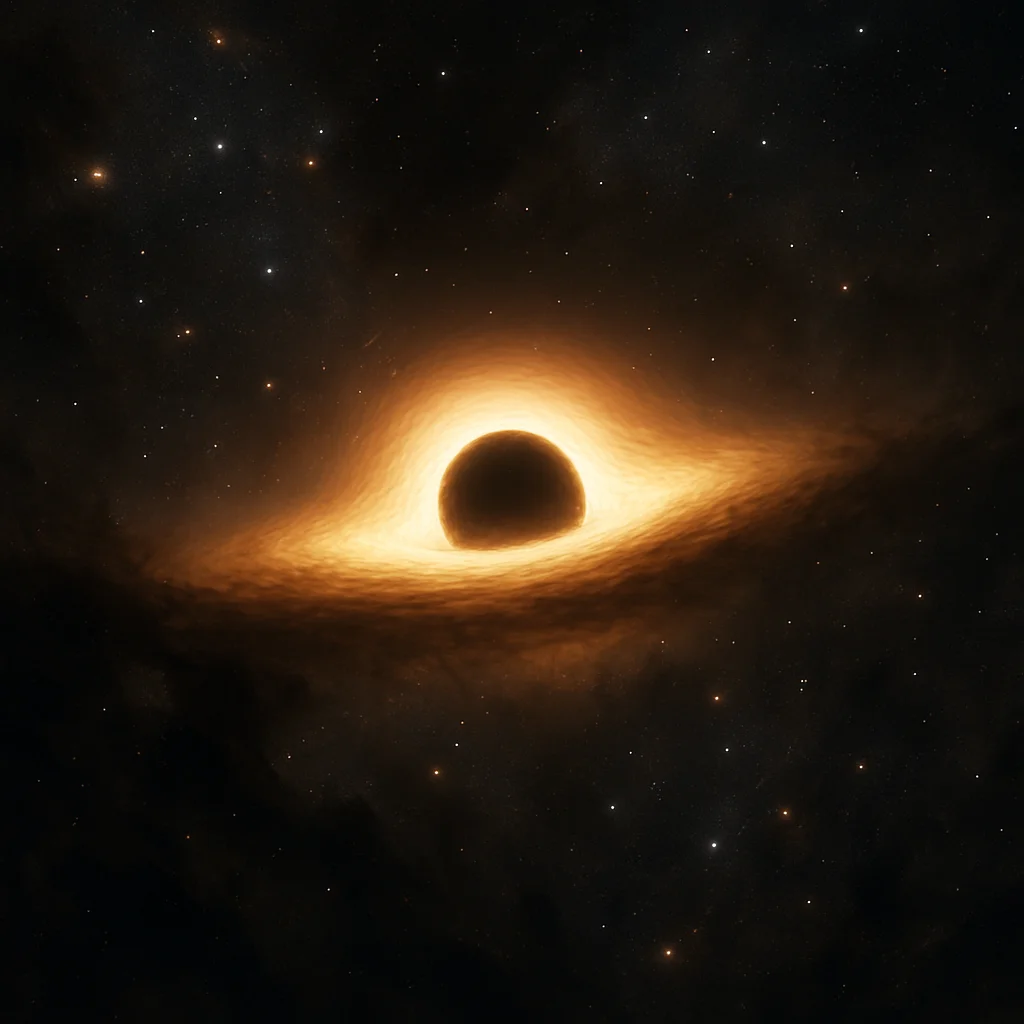
Visualization
A new paradigm is emerging at the intersection of observation, cosmology, and stellar evolution, as astronomers scrutinize the “little red dots” detected in the universe’s infancy by the James Webb Space Telescope (JWST). Recently, a team led by Vasily Kokorev at the University of Texas at Austin has harnessed the unprecedented sensitivity of Webb’s Near Infrared Camera (NIRCam) and Near Infrared Spectrograph (NIRSpec) to capture the most penetrating spectrum yet of one such enigmatic object, designated GLIMPSE-17775. The spectroscopic revelations from this investigation, published in *The Astrophysical Journal*, tip the scales decisively in favor of the “black hole star” (BH*) hypothesis—a model positing a supermassive black hole cocooned in dense, still-partially neutral primordial gas.
The observational campaign targeted the galaxy cluster Abell S1063, leveraging the phenomenon of gravitational lensing both as a magnifying glass and a time machine; light from GLIMPSE-17775, situated behind the cluster, is brightened and rendered accessible by the distorting spacetime induced by the cluster’s mass. This serendipitous alignment allowed Kokorev and colleagues to peer 12 billion years into the past, observing an object at a cosmological redshift of *z* ≈ 3.5—corresponding to an epoch just 1.8 billion years post-Big Bang.
Spectroscopic dissection revealed a palette of features unambiguously tied to the BH* scenario. Chief among these are the strong, broad emission lines indicative of highly energetic processes, yet, crucially, with profiles inconsistent with ordinary star-forming galaxies or known classes of active galactic nuclei (AGN). The spectrum displays tell-tale signatures—the presence of He II λ1640, NV λ1240, and C IV λ1549 emission, among others—whose relative intensities, ionization parameters, and line widths align with theoretical models of a supermassive black hole accreting vigorously at the center, yet still enshrouded within a massive, optically thick reservoir of ionized and nearly neutral hydrogen.
A striking element underpinning the black hole star interpretation is the energy budget implied by these emission features. The object's luminosity, enhanced by gravitational lensing by a factor μ (commonly 5–50×, depending on the lensing configuration), cannot be reconciled with ordinary stellar populations or starbursts of similar epoch and mass. Radiative transfer simulations incorporating a dense, dusty cocoon enveloping a ∼10^5–10^6 M_⊙ black hole reproduce both the observed spectral energy distribution and line ratios—a fingerprint not seen in previous discoveries. Here, the ultimate power source is not starlight from nuclear fusion but the gravitational potential energy released by matter spiraling inward to an event horizon, L_acc ∝ ηṀc^2 (where η is the radiative efficiency and Ṁ the mass accretion rate).
Within this framework, GLIMPSE-17775 provides a critical datapoint for theorists modeling the obscure transition period in which the universe’s first supermassive black holes emerged from primordial collapse, potentially shedding light on dark ages physics and the seeds of quasars that illuminate the universe at later times. The “dense gas cocoon” acts both as an accretion reservoir and a shroud reprocessing the violent radiation, a scenario that elegantly explains the object’s faintness and red-dominated observed spectrum—even within the JWST’s sensitivity reach.
The confirmation of GLIMPSE-17775 as a black hole star strengthens the growing consensus hinted at by the “little red dots” scattered through Webb’s deepest fields, yet this case stands apart in that all principal predicted signatures converge in a single target. As Dr. Kokorev remarks, “Everything fits, nothing is broken,” noting the advance from speculative hypothesis to a cohesive, testable framework. While alternative models—including extreme starbursts or exotic compact stellar clusters—have not been entirely ruled out, the multidimensional constraints from these spectral data render the black hole star hypothesis increasingly robust.
Looking forward, the team aims to construct a census of similar objects in Webb’s fields, probing their demographics and physical mechanisms. The broader astrophysical community anticipates that such observations will define the boundary conditions for early black hole formation, offering a rare glimpse into the cosmic dawn and the engines powering the very first luminaries in the universe. If these findings are replicated, the black hole star may shift from a theoretical oddity to a foundational chapter in the chronicle of cosmic structure formation—heralded, fittingly, by the faintest and reddest of cosmic beacons.
The observational campaign targeted the galaxy cluster Abell S1063, leveraging the phenomenon of gravitational lensing both as a magnifying glass and a time machine; light from GLIMPSE-17775, situated behind the cluster, is brightened and rendered accessible by the distorting spacetime induced by the cluster’s mass. This serendipitous alignment allowed Kokorev and colleagues to peer 12 billion years into the past, observing an object at a cosmological redshift of *z* ≈ 3.5—corresponding to an epoch just 1.8 billion years post-Big Bang.
Spectroscopic dissection revealed a palette of features unambiguously tied to the BH* scenario. Chief among these are the strong, broad emission lines indicative of highly energetic processes, yet, crucially, with profiles inconsistent with ordinary star-forming galaxies or known classes of active galactic nuclei (AGN). The spectrum displays tell-tale signatures—the presence of He II λ1640, NV λ1240, and C IV λ1549 emission, among others—whose relative intensities, ionization parameters, and line widths align with theoretical models of a supermassive black hole accreting vigorously at the center, yet still enshrouded within a massive, optically thick reservoir of ionized and nearly neutral hydrogen.
A striking element underpinning the black hole star interpretation is the energy budget implied by these emission features. The object's luminosity, enhanced by gravitational lensing by a factor μ (commonly 5–50×, depending on the lensing configuration), cannot be reconciled with ordinary stellar populations or starbursts of similar epoch and mass. Radiative transfer simulations incorporating a dense, dusty cocoon enveloping a ∼10^5–10^6 M_⊙ black hole reproduce both the observed spectral energy distribution and line ratios—a fingerprint not seen in previous discoveries. Here, the ultimate power source is not starlight from nuclear fusion but the gravitational potential energy released by matter spiraling inward to an event horizon, L_acc ∝ ηṀc^2 (where η is the radiative efficiency and Ṁ the mass accretion rate).
Within this framework, GLIMPSE-17775 provides a critical datapoint for theorists modeling the obscure transition period in which the universe’s first supermassive black holes emerged from primordial collapse, potentially shedding light on dark ages physics and the seeds of quasars that illuminate the universe at later times. The “dense gas cocoon” acts both as an accretion reservoir and a shroud reprocessing the violent radiation, a scenario that elegantly explains the object’s faintness and red-dominated observed spectrum—even within the JWST’s sensitivity reach.
The confirmation of GLIMPSE-17775 as a black hole star strengthens the growing consensus hinted at by the “little red dots” scattered through Webb’s deepest fields, yet this case stands apart in that all principal predicted signatures converge in a single target. As Dr. Kokorev remarks, “Everything fits, nothing is broken,” noting the advance from speculative hypothesis to a cohesive, testable framework. While alternative models—including extreme starbursts or exotic compact stellar clusters—have not been entirely ruled out, the multidimensional constraints from these spectral data render the black hole star hypothesis increasingly robust.
Looking forward, the team aims to construct a census of similar objects in Webb’s fields, probing their demographics and physical mechanisms. The broader astrophysical community anticipates that such observations will define the boundary conditions for early black hole formation, offering a rare glimpse into the cosmic dawn and the engines powering the very first luminaries in the universe. If these findings are replicated, the black hole star may shift from a theoretical oddity to a foundational chapter in the chronicle of cosmic structure formation—heralded, fittingly, by the faintest and reddest of cosmic beacons.